Auditing 101
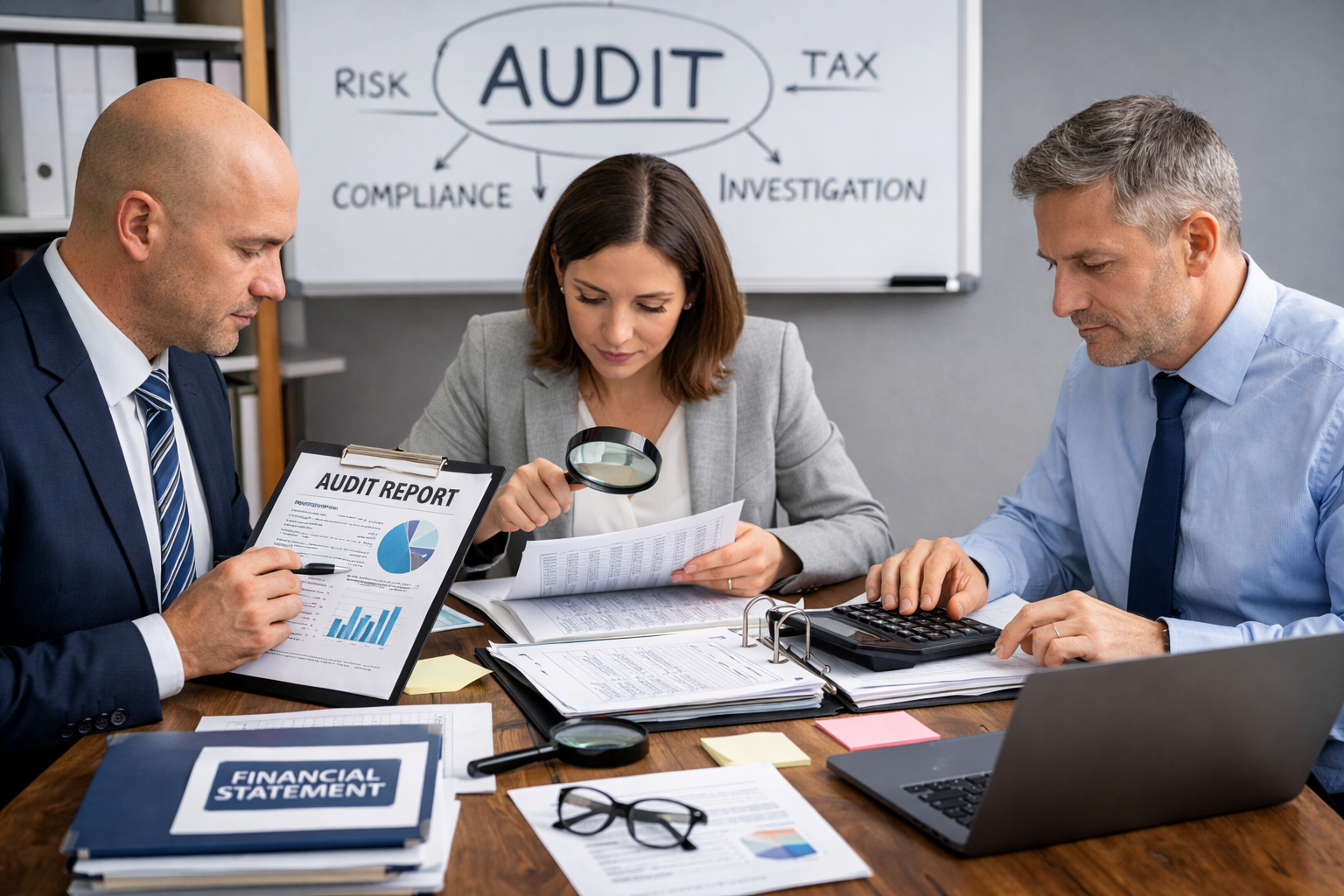
Auditing is a systematic process of evaluating information—such as financial records, operational processes, compliance activities, or IT controls—to determine whether it is accurate, complete, and aligned with defined criteria. In business, audits build trust: they help management make better decisions, assure investors and lenders, protect customers, and reduce the risk of fraud, waste, and regulatory penalties. This “Auditing 101” guide explains what auditing is, why it matters, the major audit types, how an audit is performed, and how to prepare for one.
An audit is an independent and evidence-based assessment. “Independent” means the auditor is objective and free from conflicts of interest. “Evidence-based” means findings are supported by documentation, data, observation, and other verifiable sources. Audits compare “what is” (actual records and practices) to “what should be” (standards, policies, contracts, laws, or best practices). The output is typically an audit report describing the scope, procedures performed, results, and recommendations.
- Trust and credibility: Audited information is generally viewed as more reliable by stakeholders such as investors, boards, donors, and regulators.
- Risk reduction: Audits can identify control weaknesses, errors, and fraud risks before they become major incidents.
- Better decisions: When records and performance measures are accurate, leadership can allocate resources and set strategy more effectively.
- Compliance: Many industries require audits (financial statement audits, SOC reports, ISO certifications, government contract audits, and more).
- Continuous improvement: Audit recommendations can strengthen processes, training, and governance over time.
Auditing is broader than financial statements. At its core, an audit is a disciplined process of gathering objective evidence and evaluating it against clear criteria to reach a supportable conclusion. That same approach appears across many domains—for example, compliance audits (testing whether rules, laws, or policies are followed), operational audits (assessing efficiency and effectiveness of processes), internal audits (providing assurance and advice within an organization), and information systems audits (evaluating IT controls, security, and data integrity). In each case, the details change, but the fundamentals stay the same: define criteria, collect sufficient appropriate evidence, document work, and report findings.
- Financial statement audit: Evaluates whether financial statements are presented fairly according to an accounting framework (e.g., GAAP or IFRS).
- Internal audit: Conducted by an organization’s internal audit function to assess controls, risk management, and governance across operations.
- Compliance audit: Checks adherence to laws, regulations, contracts, and internal policies (e.g., payroll tax, HIPAA, GDPR-related controls, grant requirements).
- Operational audit: Focuses on efficiency and effectiveness of processes such as procurement, inventory, customer support, or manufacturing.
- IT audit / cybersecurity audit: Reviews technology controls, access management, change management, incident response, and data protection.
- Supplier or vendor audit: Assesses third parties’ quality systems, security practices, or ethical compliance.
- Criteria: The standard used for evaluation (policy, law, contract terms, accounting standard, control framework).
- Scope: What is included and excluded—time period, locations, business units, systems, accounts, or processes.
- Materiality: The threshold where an error or omission could influence a reasonable user’s decision (commonly used in financial audits).
- Audit risk: The risk that auditors reach an incorrect conclusion. Often broken into inherent risk, control risk, and detection risk.
- Internal controls: Processes designed to provide reasonable assurance over reporting reliability, operational effectiveness, and compliance.
- Evidence: Documents, logs, reconciliations, confirmations, observations, interviews, and analytical results supporting findings.
- Findings and recommendations: Observed issues (condition) compared to what should exist (criteria), including impact and corrective actions.
Most audits follow a consistent lifecycle. Specific steps differ by audit type, but the logic is similar: plan the work, test what matters, evaluate results, and report clearly.
- Engagement and planning: Define objectives, scope, timeline, and roles. Auditors learn the business, identify key risks, and design an audit plan.
- Understanding the process and controls: Auditors document workflows (e.g., revenue, purchasing, payroll, user access provisioning) and identify control points.
- Risk assessment: Focus effort on areas with higher likelihood or impact of error, fraud, noncompliance, or system failure.
- Designing audit procedures: Select tests and analyses that generate sufficient, appropriate evidence (sampling, walkthroughs, data analytics, confirmations).
- Fieldwork and testing: Execute procedures, gather evidence, and document results. Examples include checking reconciliations, inspecting approvals, or reviewing system logs.
- Evaluation and conclusions: Determine whether exceptions are isolated or systemic, and whether they indicate control failures or process breakdowns.
- Reporting: Communicate results, severity, root causes, and recommendations. For financial audits, this may include an audit opinion.
- Follow-up (especially for internal audits): Verify that corrective actions were implemented and are effective over time.
Strong audit evidence is relevant, reliable, and sufficient. Auditors typically prefer evidence that is independent (from third parties) or system-generated with strong controls. Evidence quality also depends on how well it is documented and whether it can be reproduced.
- Documents and records: Invoices, contracts, bank statements, board minutes, policy documents.
- Reconciliations and schedules: Bank reconciliations, aging reports, inventory counts, fixed asset registers.
- Confirmations: Third-party verification (banks, customers, suppliers).
- Observation and inspection: Watching a physical inventory count, inspecting security controls in a data center.
- Interviews and walkthroughs: Talking with process owners and tracing a transaction from start to finish.
- Data analytics: Trend analysis, duplicate payment detection, unusual journal entry screening, access log reviews.
Internal controls are the guardrails that help organizations prevent mistakes and detect problems early. Audits often assess whether controls are designed well (design effectiveness) and whether they are actually performed consistently (operating effectiveness). A classic control goal is separation of duties—ensuring one person cannot initiate, approve, record, and reconcile the same transaction without oversight.
- Preventive controls: Stop errors before they occur (approval limits, system access restrictions).
- Detective controls: Identify issues after the fact (reconciliations, variance analysis).
- Corrective controls: Fix problems and reduce recurrence (remediation plans, retraining, system configuration changes).
Good audit preparation is less about scrambling and more about routine discipline. Organizations that keep records organized and processes consistent tend to experience smoother audits, fewer surprises, and quicker turnaround.
- Assign an audit owner: Designate a point person to coordinate requests, timelines, and responses.
- Clarify scope early: Confirm which period, entities, systems, or locations are included so you gather the right materials.
- Organize documentation: Maintain clear folders for policies, contracts, reconciliations, reports, and key approvals.
- Close the books on time: For financial audits, ensure reconciliations are completed and reviewed before fieldwork begins.
- Document key processes: Simple flowcharts or written procedures help auditors understand how work is performed.
- Respond efficiently: Provide complete, consistent support for requests. If something is unavailable, explain why and propose alternatives.
- Treat findings as improvement opportunities: Ask about root causes and practical remediation steps rather than focusing only on “passing.”
- Missing approvals: A control may be designed but not consistently performed or documented.
- Late or unreconciled accounts: The close process may be understaffed, unclear, or lacking review discipline.
- Access control issues: Too many users have privileged access, or terminated employees still have accounts.
- Policy gaps: Procedures exist in practice but are not formalized, leading to inconsistent execution.
- Data quality problems: Source systems may allow duplicates, manual overrides, or inconsistent coding.
Audit reports vary, but strong ones are clear, fair, and actionable. They distinguish facts from opinions and provide enough context for leaders to decide what to do next.
- Objective and scope: What was audited, when, and under what criteria.
- Methodology: High-level description of procedures performed (tests, sampling, interviews).
- Findings: The condition observed, the expected criteria, and supporting evidence.
- Impact and risk: Why the finding matters (financial, operational, compliance, reputational).
- Root cause: The underlying reason the issue happened (training, system design, unclear ownership).
- Recommendations and management response: Proposed actions, owners, and timelines for remediation.
Audits are most effective when everyone treats them as a structured learning process rather than a confrontation. Auditors should be objective, maintain confidentiality, and communicate respectfully. Audited teams should be honest, provide complete information, and ask clarifying questions. A strong audit relationship relies on transparency: surprises are reduced when risks and constraints are discussed early.
- Key policies are current, approved, and accessible (finance, procurement, security, HR).
- Reconciliations are completed on schedule and show evidence of review.
- Roles and responsibilities are clear, especially for approvals and system access.
- Critical reports and metrics can be reproduced from source systems.
- Change management is documented for systems and key spreadsheets.
- Exceptions and incidents are tracked, investigated, and resolved.
Auditing is a structured way to verify trustworthiness—of numbers, processes, and controls. Whether you’re facing a financial statement audit, an internal review, a compliance check, or an IT assessment, the fundamentals are the same: define criteria, gather evidence, evaluate risk, and report clearly. Organizations that view audits as part of routine governance—not a once-a-year emergency—tend to improve faster, reduce risk, and make stronger decisions. Auditing, at its best, is not just about finding problems; it’s about building resilient systems that prevent problems in the first place.
Which statement best describes the purpose of an audit?